
Searching the Wharton County Court Docket
Start with the court named on your citation, notice, pleading, or prior order. That single detail tells you which office to ask. The Wharton County District Clerk points visitors to online records. Those cover both civil and criminal matters in the district courts. The Wharton County Clerk handles the county-level side, covering civil, criminal, probate, and guardianship records. Justice court and municipal cases stay with the precinct or city court that filed them. Bring a name, a cause number, the court, and a rough filing date. With those, a Wharton County court docket search gets much sharper.
No one screen holds every Wharton County court docket. The county-linked iDocket service covers records tied to both clerk offices. Images and access can depend on an account or a fee. re:SearchTX adds a state layer for participating courts. The Texas Citations and Notices portal serves a narrower notice search. Each city runs its own citation route. If nothing turns up online, call or write the right clerk, or visit the counter. An empty web result does not mean no case exists.
- Read the document in hand and identify the issuing court.
- Use the county-linked portal, the relevant city portal, or re:SearchTX for that court.
- Search with the full cause number when available. Otherwise use a name and date range.
- Check the court, filing events, status, and next setting before assuming the result is a match.
- Ask the record custodian for a plain or certified copy when the docket index is not enough.
Wharton County iDocket Access
Both Wharton County clerk pages link out to Cott/iDocket for electronic access. The service lets you search by party, filing date, attorney, county, court, or state and cause number. The exact fields vary with your subscription level. Coverage runs deep. The county's own login page says its public-document index and images reach back to 1845. The vendor's coverage table lists separate district and county clerk rows with images. Treat those as clues. They are not a promise that every Wharton County court docket or filing is online.
The Wharton County iDocket login posts its rates plainly. You pay $25 for a 24-hour subscription, $200 for 30 days, and $1 per image. One catch matters. Purchased images must be printed within 24 hours, so confirm the terms before you pay. A free County Clerk iDocket landing page also exists. It aims mainly at public-document searches and property-fraud alerts. It is handy. But it does not replace the Wharton County court docket each clerk keeps in house.
Subscribers start at the county-linked iDocket account screen, which shows the sign-in fields for paid Wharton County access.
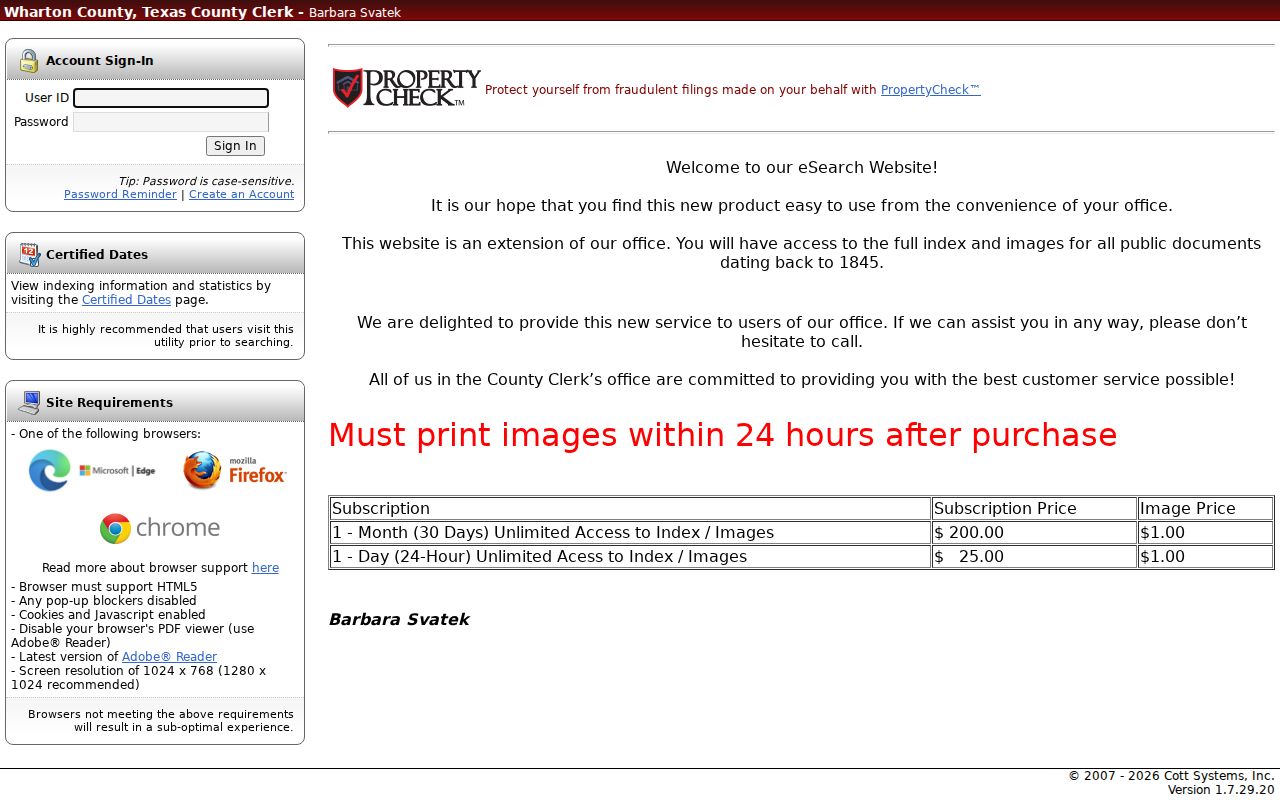
The page makes the account step plain before any paid docket image will open.
| Search detail | Why it helps | Limit |
|---|---|---|
| Party or attorney | Finds a case when the number is unknown | Common names may return several records |
| Cause number | Narrows the result to one court file | The exact local number is best |
| Court and date | Separates clerk rows and filing periods | Coverage differs by court and record type |
| Document image | Shows a filing behind the index | Account and image charges may apply |
The official Wharton County Clerk search landing page shows the public entry point to its online index.
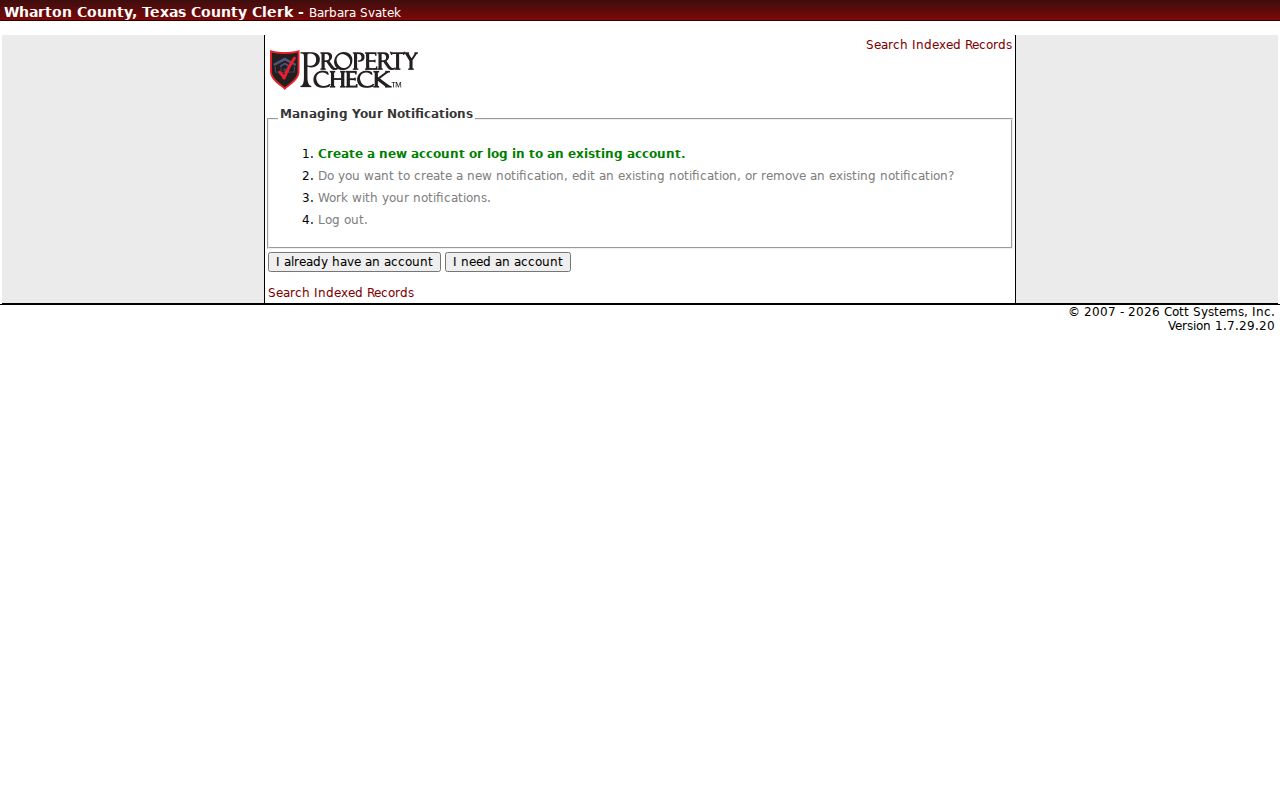
That scope is a reminder: a public-document index is not the same thing as a complete court docket file.
Inside a Wharton County Court Docket
Think of a Wharton County court docket as an event log, not the whole file. Cause number, court, case type, parties, attorneys, filing dates, settings, orders, and disposition status can all appear on it. An online portal may show only part of that list. A document title proves something was filed, nothing more. It may not reveal the ruling or the full text. An entry marked disposed means the court recorded an outcome, but it does not spell out every legal effect of that result.
| Cause number | The identifier assigned by the filing court; punctuation and prefixes must be entered as the portal expects. |
|---|---|
| Parties | The named sides in a public case, subject to redaction and access limits. |
| Docket entries | Dated filings, notices, orders, returns, and other recorded events. |
| Settings | The date and type of a scheduled event, which may change after posting. |
| Court | The district, county, justice, municipal, child-protection, or other court responsible for the matter. |
| Disposition | The recorded outcome or status, which should be read with the related order. |
Context matters when reading entries. A reset moves a setting; it never dismisses the case. A file date shows when the clerk accepted the paper. That is not always when the event happened. The safest habit pairs the Wharton County docket line with the filed order or notice, then confirms the current date with the clerk.
Wharton County Docket Terms
Short entries save space. They can blur the line between a filed paper, a scheduled event, and a final ruling. The terms below help decode a Wharton County court docket. When meaning affects a deadline, trust the actual entry and its linked order.
- Setting
- A scheduled court event, such as an arraignment, status conference, hearing, or trial.
- Continuance
- A court-approved move of an event to a later date.
- Reset
- A new setting date entered after the prior setting changes.
- Disposition
- The result recorded for a case or charge.
- Sealed
- A record placed outside ordinary public access by law or court order.
Courts That Keep Dockets in Wharton County
Texas splits trial work by subject and by level. The 23rd and 329th Judicial District Courts sit at the top. They handle felony, family, land-title, election, and higher-value civil matters. The constitutional County Court takes county-level criminal, probate, and civil work within its authority. Below that, four justice precincts hear fine-only misdemeanors, evictions, small claims, and similar lower-court cases. The Wharton, El Campo, and East Bernard municipal courts each keep their own dockets. Those cover ordinance and fine-only Class C cases.
| Court | Docket Covers | Where to Search |
|---|---|---|
| 23rd and 329th District Courts | Felony, family, land-title, election, and higher-value civil matters | District Clerk and county-linked civil/criminal records |
| Wharton County Court | County criminal, probate, and civil matters within jurisdiction | County Clerk and posted County Court status docket |
| Justice Courts, Precincts 1-4 | Fine-only cases, small claims, evictions, and magistrate work | The named precinct office |
| Municipal Courts | City ordinance and fine-only Class C matters | Wharton, El Campo, or East Bernard court |
Child-protection cases follow a separate path. The state-run Coastal Bend Children’s Court docket lists Wharton County dates, and local standing orders also point to the 329th District Court. Federal cases differ again. Wharton County falls under the Southern District of Texas, Houston Division. A county address alone never puts a case on a state court docket.
Wharton County Portal Choices
iDocket and re:SearchTX overlap without being the same tool. The county steers its clerk users toward iDocket. The statewide re:SearchTX access page works through registration or an eFileTexas sign-in. It supports case, filing, document-text, and hearing searches across participating records. Its help material adds filters, saved searches, and exports. Wharton County coverage, especially for criminal records, should be confirmed in the live service itself.
When you know the court and clerk, take the county route. Use re:SearchTX as a wider second pass. Or turn to it when a filing may have crossed the state exchange. For a published citation or notice, the Texas Citations and Notices search offers General Search, Name, Cause Number, Court/County, and Status fields. Its tips allow a trailing wildcard like joh*. None of these tools substitutes for direct confirmation by the court that owns the Wharton County docket.
How to Find Court Dates and Settings
Start with the posted list, but treat it as a plan that can shift. The Wharton County Judge page carries a dated County Court Status Docket. It warns settings may change before court begins. So a hearing date on that page is a plan, never a promise. For district court settings, the District Clerk or the court coordinator is the right contact. Justice and municipal settings go through the named lower court itself. The Coastal Bend Children’s Court offers a date selector for its Wharton County calendar. Its landing page does not open individual child-protection facts. Read the setting type, not just the date. Arraignment, pretrial, status, motion, plea, and trial settings each do different work. Scan for later reset, continuance, or cancellation entries. Then confirm with the court before you rely on any date. The detailed Wharton County court dates page walks through each calendar channel. It explains which fields make a setting usable.
Wharton County Filing Traffic
Why does precision matter in a Wharton County docket search? Because the local courts handle wildly different streams of work. OCA’s FY2024 county summary puts district civil filings first in its count. It counted 496 of them. New family filings came to 269. Juvenile filings numbered 32, and new felony cases 321. Justice courts logged 1,084 new civil cases and 5,749 new criminal cases. Municipal ending caseloads ran 5,138 in El Campo. Wharton stood at 2,363, and East Bernard at 626. None of these figures are live docket counts. They measure aggregate activity and say nothing about any person.
A full cause number plus the issuing court cuts straight through that volume. Rely on a name-only Wharton County docket search and you risk false matches or a trip to the wrong clerk.
Public Access to Court Dockets
Texas court access is not governed by one broad rule. The Texas Public Information Act covers most government records. Yet the judiciary holds a statutory carve-out. Texas Rule of Judicial Administration 12 reaches judicial administration records, not the ordinary case files. Those files follow the rules and law of the court that holds them. Rule 76a governs sealing of civil court records. In Wharton County the result is a split system. An open index sits beside redacted, restricted, or sealed documents.
Key Texas rules:
Government Code Chapter 552 states the public-information policy and includes the judiciary distinction.
OCA open-records policy explains why Rule 12 and court case records use different access paths.
Texas Rule 12 provides a request and appeal framework for judicial records while excluding case records.
Texas Rule of Civil Procedure 76a supplies the sealing standard and presumption for civil court records.
Juvenile, child-protection, sealed, and some family material may be withheld or limited. A case name or docket event can be visible while the document behind it stays closed online. Send access questions to the clerk holding that Wharton County court record.
Wharton County Restricted Records
Access limits attach to specific records, not to dockets in general. Juvenile and child-protection files get strong protection. Adoption records and certain family material may be restricted too. A judge can seal records under governing law. A portal can respond in several ways: no result, a short index, or a document that will not open. Those outcomes do not mean the same thing. One may point to the wrong court. Another may reflect incomplete electronic coverage, delayed indexing, redaction, restricted access, or a sealing order. Try the cause number with and without punctuation, and narrow the court and date range. Check both the county and state layers. Still nothing? Ask the Wharton County Clerk or District Clerk whether the file is held there and what request method applies. Do not ask staff to disclose protected facts. Ask about the public index, the copy process, and whether a court order or proof of authority is needed. Note: a blank portal result is not proof that a Wharton County court docket never existed.
Docket Records at the Clerk's Office
Wharton County runs two main clerk offices rather than one universal docket counter. District Clerk Kendra Charbula keeps district civil and criminal records. The office sits at 103 S Fulton Street, reachable at (979) 532-5542. County Clerk Barbara Svatek’s office sits at 309 E Milam Street, Suite 700. It handles county civil, criminal, probate, guardianship, and recording work. Vital-statistics work runs through a separate channel. Listed hours run Monday through Friday, 8:00 a.m. to 5:00 p.m. The office closes from noon to 1:00 p.m. The District Clerk page posts the county's official district record contacts and links.
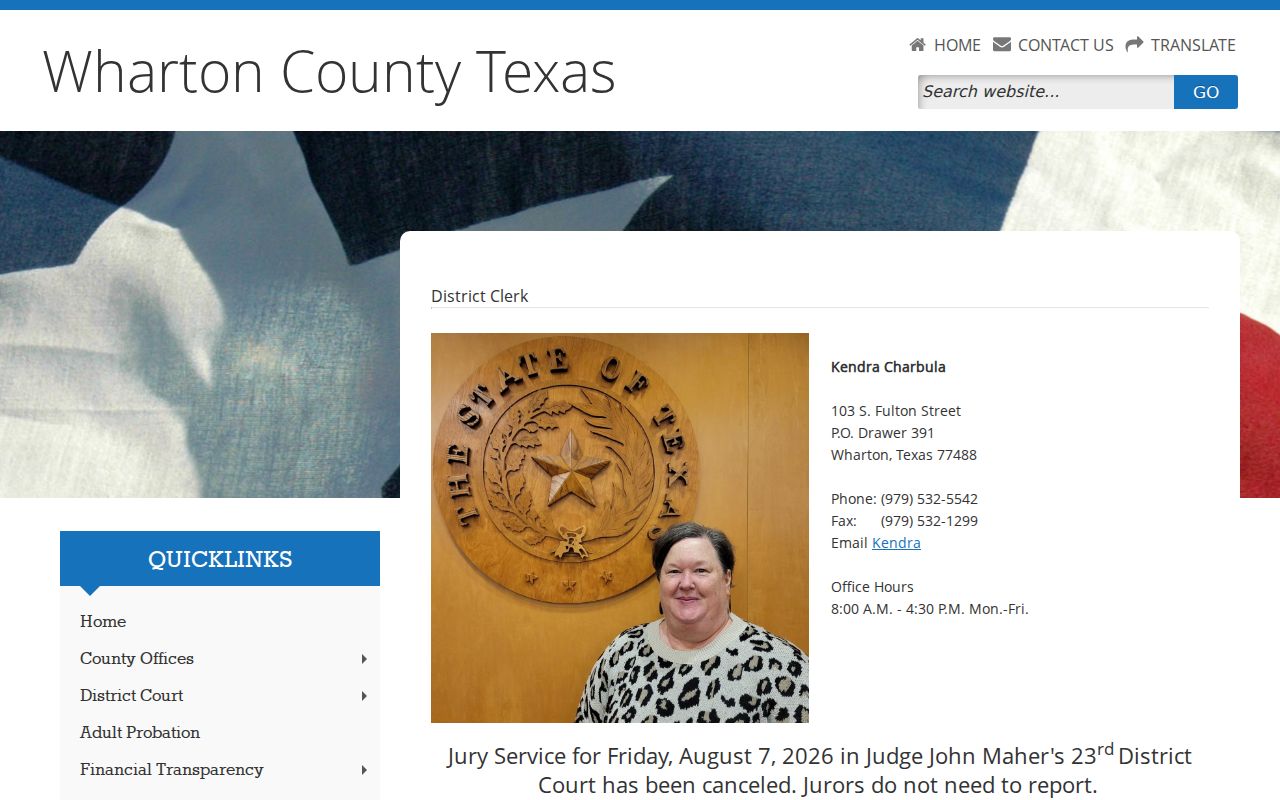
For questions about district civil and criminal docket records, this office is the place to call.
Wharton County District Clerk
103 S Fulton Street, P.O. Drawer 391
Wharton, TX 77488
(979) 532-5542
Wharton County Clerk
309 E Milam Street, Suite 700, P.O. Box 69
Wharton, TX 77488
(979) 532-2381
The County Clerk page separates its public record and court functions by department.
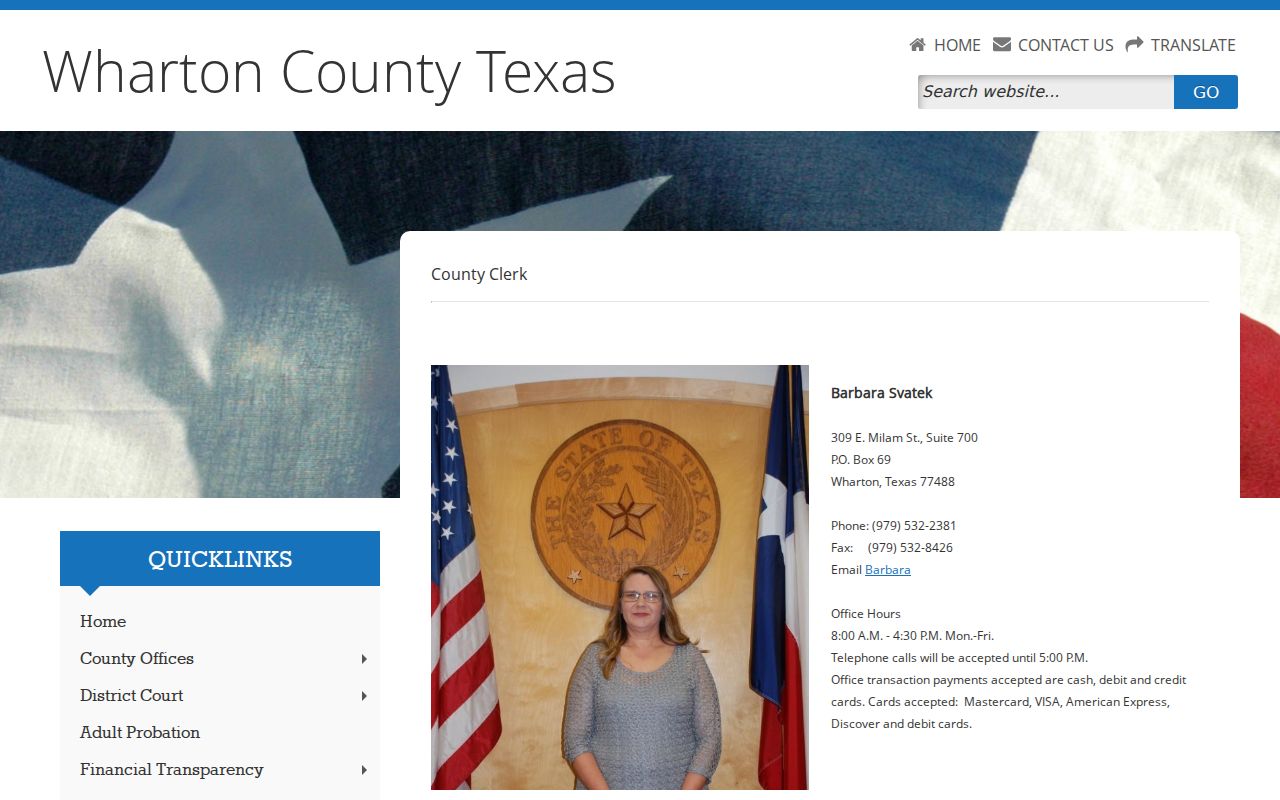
That split is a practical reminder. Name the record type when calling about a Wharton County docket. Call before a trip. Confirm the right desk, current hours, copy method, and fee. A mailed request should state the court, cause number, document, and whether certification is wanted. A plain docket printout and a certified copy serve different needs.
Wharton County E-Filing History
eFileTexas handles electronic filing for participating Texas courts, but a submission there is not yet a Wharton County court docket entry. Each document travels through submission and clerk review first. Only after acceptance does it join the official case record. So keep the two documents straight: the filing receipt proves delivery, while the clerk's docket is the case history that counts in court.
Texas record exchange keeps evolving. OCA material describes re:SearchTX integration work and a November 1, 2025 direction involving district and county clerks. The City of Wharton moved earlier still. It authorized an electronic ticket process back in 2010. That process scanned license and registration data to push citation information into municipal court. Each system does one job. Electronic filing, county case access, and city citation handling stay separate even when all three live on a screen.
The Wharton County Courthouse Record
Wharton County's active courthouse gives docket work a long physical setting. The Texas Historical Commission covers the 1889 Second Empire building, its restoration, and a 2007 rededication. Its Texas Historic Sites Atlas entry places the courthouse at 100 S Fulton Street and notes that county government still uses it.
Do not treat that landmark as the mailing address for every record request. The District Clerk sits at 103 S Fulton, the County Clerk at 309 E Milam, the district judges work from separate suites, and justice counters sit across the county. Any Wharton County docket search starts with which court handled the case, not with the guess that all files sit at one window.
Wharton County Court Dockets by City
The official regional plan counts three incorporated cities. So the Wharton County city docket list ends at three. El Campo, Wharton, and East Bernard each run a municipal court. It handles ordinance violations and fine-only Class C matters. Those city dockets stand apart from district, county, and justice dockets. Check which city printed the citation. That name tells you which local portal or clerk gets the first inquiry. Population figures below come from 2020 Census counts and only rank the three profiles.
El Campo Docket Search
12,350 · Search the municipal citation portal or contact the city court.
Wharton Docket Search
8,627 · Use the city portal for municipal citations, not county iDocket.
East Bernard Docket Search
2,218 · Start with the municipal clerk or the GovRec payment route.
El Campo and Wharton offer municipal citation search portals with several lookup paths. East Bernard works differently: go through the clerk first, and a separate payment service requires a citation number. A county or district case involving a city resident still belongs with the county court named in that case, never the municipal court.
Map and Directions to the Wharton County District Clerk's Office
District civil and criminal case files for the 23rd and 329th District Courts are kept at the Wharton County District Clerk's office, 103 S Fulton Street, in downtown Wharton. The district courtrooms themselves sit a short distance away at the historic 1889 courthouse, 100 S Fulton Street, so a filing or docket question should go to the Clerk's address rather than the courthouse building. The County Clerk's separate office, 309 E Milam Street, Suite 700, handles county-level civil, criminal, probate, and recording matters.
Wharton County District Clerk
103 S Fulton Street, P.O. Drawer 391
Wharton, TX 77488
(979) 532-5542
Monday through Friday, 8:00 a.m. to 4:30 p.m.
Bring the cause number, party names, or a filing-date range when asking for a docket sheet, since the Clerk's staff work from those identifiers rather than open browsing. No Wharton County page publishes a courthouse-area parking or security policy, so calling the District Clerk before a trip confirms current entry rules and copy costs.